10 Camping Mistakes Beginners Probably Making

Spread the love

My early camping career was less “Bear Grylls” and more “a bear would look at my setup and weep with pity.”

I’ve spent nights shivering in a condensation-soaked sleeping bag, slid down a tent like a human slug in a nylon tube, and woken up with feet so cold I was convinced I’d donated my toes to science overnight.

Through a process of trial, error, and profound humiliation, I’ve learned that most camping woes aren’t caused by bad weather, but by simple, avoidable mistakes.
In fact, I’d bet my last dry sock that most campers are unknowingly making at least five out of the ten blunders on this list.

But fear not, fellow adventurer! This post is your intervention.
We’re going to walk through these common tent sins, I’ll explain why they turn your cozy refuge into a damp, chilly prison, and I’ll give you the practical, battle-tested solutions to avoid them.

1. The Vestibule Backpack Blunder: Creating Your Personal Indoor Rainforest

The Common Mistake

You roll into camp, exhausted and triumphant. You shuck off your backpack and, with the graceful arc of a defeated shot-putter, you heave it into the corner of your tent’s vestibule.
Done. Dusted. Time for dinner.

The Problem

What you’ve just done is architect your own personal sauna.
That vestibule isn’t just a fancy porch for your muddy boots; it’s a critical airflow chamber.
Your tent breathes, and moisture from your breath and body wafts out, needing to escape.
By plonking your giant pack against one side, you’ve created a dam.
The moist air gets trapped, hits the cooler fabric of the tent, and—voilà!—you wake up to a beautiful, shimmering constellation of condensation droplets on your inner tent wall.
A gentle shake, and you’ve got your own indoor drizzle. Good morning!

The Solution:

The Centered Zen Approach: Place your backpack right in the middle of the vestibule floor. This keeps the airflow channels around the sides clear, allowing moisture to escape efficiently.
The Indoor Option: If it’s not too muddy or bug-filled, just bring the darn thing inside the tent with you. Lay it flat at your feet, ensuring it’s not blocking any mesh panels or vents.
Visual Tip: Before you zip up for the night, do a quick check. Can you see a clear path for air to move from the tent mesh, through the vestibule, and out into the world?
If your gear is creating a wall, you’re building a cloud.

2. Location, Location, Condensation: Picking the Wrong Real Estate

The Mistake

You see a beautiful, wide-open meadow. “Perfect!” you think. “Unobstructed views! Flat ground!”
And while that is lovely for star-gazing, it’s the equivalent of setting up your tent in the middle of a wind tunnel with full exposure to the elements.

The Ideal Setup

Think like a squirrel. You want a little bit of cover. Pitching your tent near a line of trees or a large rock formation acts as a natural windbreak and provides some shade.

This slight protection does two magical things: 1) It drastically reduces wind chill, which sucks heat from your tent, and 2) It can raise the temperature inside your tent by a few crucial degrees. 

In the morning, it also protects you from the sun, reducing that “wake-up-in-a-sweaty-plastic-bag” feeling.

Safety Caution

Now, don’t go getting yourself squashed. NEVER set up camp directly under a dead tree (a “widowmaker”) or even a large dead branch on a live tree.
Look up! The goal is to be near trees, not directly underneath their most precarious limbs. Smaller, younger, healthy trees are your friends.

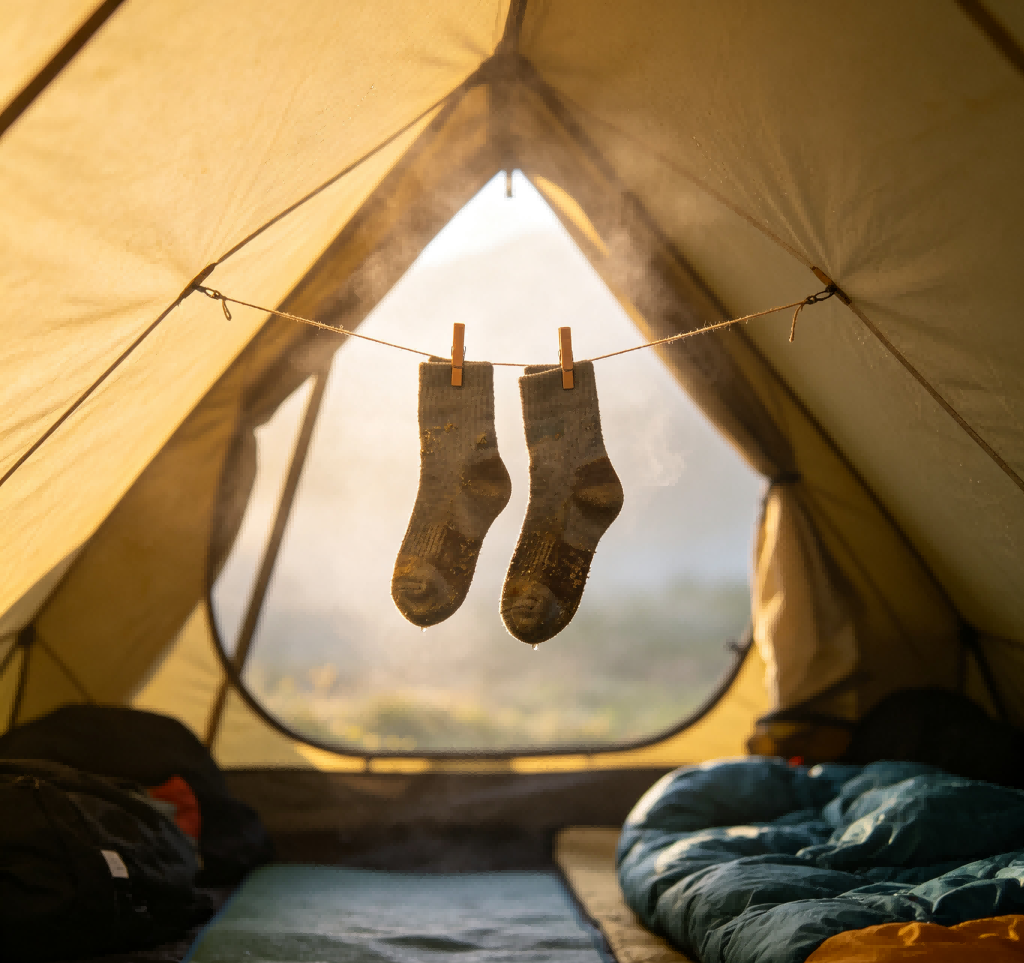
3. The Indoor Laundry Service: Why Wet Socks Don't Belong in Your Bedroom

The Mistake

Your shoes are soaked. Your socks are… let’s not talk about the socks.
It’s cold, and you don’t want them to get frosty outside, so you bring them into the tent.
Seems logical, right? Wrong. So, so wrong.

The Consequence

You have just moved a pint of water into your sealed sleeping environment. That moisture will evaporate from your gear and hang in the air of your tent.
Since the tent walls are colder than the air inside, the moisture condenses on them. Now, not only are your shoes still wet, but your sleeping bag, your pillow, and your spare clothes are also damp.
You have successfully created a mobile humidity chamber.

The Solution

The Isolation Chamber: Shove all your wet gear into a dry sack or a sturdy trash bag, squeeze out the air, and seal it tight.
This traps the moisture. You can then use this bag as a makeshift pillow (multi-tasking!).
The Daylight Gambit: The best way to dry gear is with good old-fashioned sunlight and a breeze.
Layout your wet stuff during the day when you’re breaking camp or taking a lunch break. Your tent is for sleeping, not for running a failing laundromat.

4. The Toasty Torso Technique: It’s All About the Core

The Key Principle

I used to think warm feet were the key to a good night’s sleep. Then I learned a vital lesson: your body is a selfish dictator.
If your core (your chest and torso) gets cold, it pulls blood away from the extremities (your hands and feet) to protect your vital organs.
So, no matter how many socks you wear, if your core is cold, your feet will be icy little stumps.

Tips to Win the War

The Under-Mat Insulator: An empty backpack isn’t just for carrying things.
Placed under your sleeping mat, especially in the torso area, it adds a crucial layer of insulation between you and the cold, heat-sucking ground.
It also adds a bit of padding, making your bed feel plusher. It’s a win-win.

5. The Slip 'n' Slide Slope Situation

The Mistake

You find a spot that’s almost flat. “It’s barely a slope,” you tell yourself. “I’ll barely notice it.” Oh, you will notice.
Around 2 AM, you’ll notice you’ve slowly migrated downhill and are now compressed against the tent wall like a pressed flower.

The Problem

Gravity is a relentless, nocturnal enemy. As you sleep, you imperceptibly slide. Your feet press against the bottom of the tent, which is often mesh.

This not only strains your sleeping bag but also transfers your body heat directly to the cold outer tent, creating a lovely puddle of condensation right where your feet live. You wake up with a damp sleeping bag and the posture of a banana.

Solutions:

The Mesh Brace: Simply orient yourself so your feet are against one of the mesh sidewalls of the tent, not the end wall. The mesh provides grip and stops the slide, and your body heat is less likely to cause condensation there.
The Foot-Locker: Remember that empty backpack from Tip #4? If it’s not under your mat, put your feet inside it at the bottom of your sleeping bag. It acts as a brake to stop the slide, provides extra insulation for your feet, and keeps them dry from any condensation. It’s like a little sleeping bag for your sleeping bag’s feet.

6. The Cold-Air Bathtub: Why Valleys are Freezing

The Mistake

You find a lovely, sheltered, flat depression in the ground. “It’s so cozy!” you coo. It is not cozy. It is a cold-air sink.
You have, essentially, pitched your tent in a bathtub that will slowly fill with freezing air all night long.

The Science Tip

Cold air is denser and heavier than warm air. Just like water, it flows to the lowest point it can find. That beautiful, sheltered valley is a magnet for every bit of cold air for a mile around.

Let Me Illustrate with a Bonkers Fact: Think of the Cetal Sinkhole in Austria. It’s about 1,400 meters (4,593 ft) high. Meanwhile, Mont Blanc is 4,807 meters (15,774 ft) high. 

Yet, the sinkhole has recorded temperatures lower than the peak of Mont Blanc!

 How? Because it’s a giant, natural bowl that collects and traps cold, dense air. Your little depression is a mini-Cetal Sinkhole.

The Advice

Always try to set up your tent on a slightly higher point or a gentle slope. Get yourself out of the drainage path of that cold, invisible river. 

A few feet of elevation can make a temperature difference of 10 degrees Fahrenheit or more.

7. The Dragon’s Breath: Don’t Cook Your Sleeping Bag

The Mistake

It’s freezing. Your face is cold. The instinct is to burrow deep into your sleeping bag and breathe the warm, moist air inside.
It feels so good for about five minutes.

The Problem

Your breath is loaded with moisture. By breathing directly into the insulation of your sleeping bag, you are saturating it with water vapor.
Wet down or synthetic insulation clumps together and loses its ability to trap heat. You are, quite literally, destroying your sleeping bag’s warmth from the inside out.
You’ll start the night warm and end it a shivering, damp mess.

The Solution

This is where a buff or a similar neck gaiter becomes a piece of survival genius. Pull it up over your nose and mouth.
It creates a barrier, trapping the moisture from your breath in the fabric (which will frost up, which is fine) and keeping it out of your bag.
Your face stays warm, your bag stays dry, and you stay alive. It’s the ultimate multi-tasker.

8. The Sock Strangulation: Why Tighter Isn’t Warmer

The Mistake

Your feet are cold. Your brain says, “More layers! Tighter socks!” So you jam your feet into a second, tighter pair of socks, cutting off circulation and wondering why you’re now a popsicle.

The Problem

Insulation doesn’t work by being tight; it works by trapping air. The loft in your socks and sleeping bag creates tiny pockets of warm air around your body.
If you wear socks that are too tight, you compress that insulation and, more critically, you restrict blood flow.
Your blood is your body’s central heating system. No blood flow, no heat. You’ve just put a tourniquet on your own warmth.

Solutions

The Fresh Sock Swap: Always put on a fresh, clean, and loose-fitting pair of socks before bed. The clean ones are drier and will loft better.
The Pre-Warm Maneuver: Before putting on those dry socks, take a moment and warm your feet with your hands. Rub them, stick them on your warm belly (or a willing, long-suffering partner’s back), just get some blood flowing. Putting dry socks on pre-warmed feet is like putting a cozy blanket on a radiator instead of a block of ice.

9. The Tech & Filter Freeze-Out: Don’t Let Your Gear Die

The Cold Weather Issues

Water Filters: That fancy (and expensive) water filter has a delicate membrane inside. When water inside it freezes, it expands. This can create micro-fractures, rendering the filter useless and potentially allowing nasty bugs to pass through. If it freezes, you can’t trust it again.
Electronics: Your phone, GPS, camera—they all hate the cold. Batteries drain at an alarming rate, they can refuse to charge, and screens can become laggy or unresponsive.

The Solution

Your sleeping bag is the ultimate life-support system. On cold nights, your water filter (in a plastic bag, in case of leaks) and your essential electronics get to sleep with you.
Tuck them down by your feet or alongside your core. Your body heat will keep them functioning and ready for action in the morning. It’s a slumber party for survival.

10. The Flappy Mess: Stabilizing Your Tent Like a Pro

The Mistake

You’re in a hurry, so you peg out the corners of your tent straight out, or you toss the guylines haphazardly.
The wind picks up, and your tent transforms into a flapping, shuddering monstrosity that sounds like it’s about to achieve liftoff.

The Solution

This one is simple geometry. Always set your corner pegs and guylines at a 45-degree angle away from the tent. Not straight out, not straight down. A 45-degree angle.

The Benefits

Stability: This creates opposing forces that keep the tent fabric taut and stable. The tent sits straight and can withstand much stronger winds.
Security: The stake is pulled into the ground, not up and out of it. It’s far more secure, meaning you won’t wake up to the sound of a guyline peg shooting past your head like a missile.

Conclusion

I’ll admit it freely—I have been guilty of every single one of these mistakes.
I’ve been the human landslide, the creator of indoor rain, and the guy who nearly froze his toes off because of overly ambitious socks.

But the beauty of camping is that it’s a constant learning curve. Each mistake is a story, and each solution makes the next trip even better.

The goal isn’t to be perfect; it’s to be comfortable enough to truly enjoy the incredible experience of sleeping outside. So learn from my many, many errors. Tweak your setup. Embrace the buff.

Leave a Comment

Your email address will not be published. Required fields are marked *

Scroll to Top