Table of Contents
1. Adopt the “Slow is Smooth, Smooth is Fast” Mentality
My early philosophy was “FRANTIC IS SPECTACULAR.” Need fire? Let me whirl around like a windmill made of matches, scattering tinder to the four winds.
Need to set up camp before dark? Behold my interpretive dance of stumbling and frantic pole-arranging!
I learned this lesson the day I tried to process firewood while mentally already eating the hypothetical fish I hadn’t caught yet.
My knife, in a hurry, decided my thumb looked like a suitable substitute for the feather stick. A single, deliberate cut would have taken three seconds.
The bandaging, swearing, and loss of dignity took roughly three hours.
The Hack: Your brain in the woods is like a skittish horse. If you yank the reins and shout, it bolts. If you move with calm, deliberate purpose, you actually get places.
Chopping wood? Focus on the one perfect swing, not the whole pile.
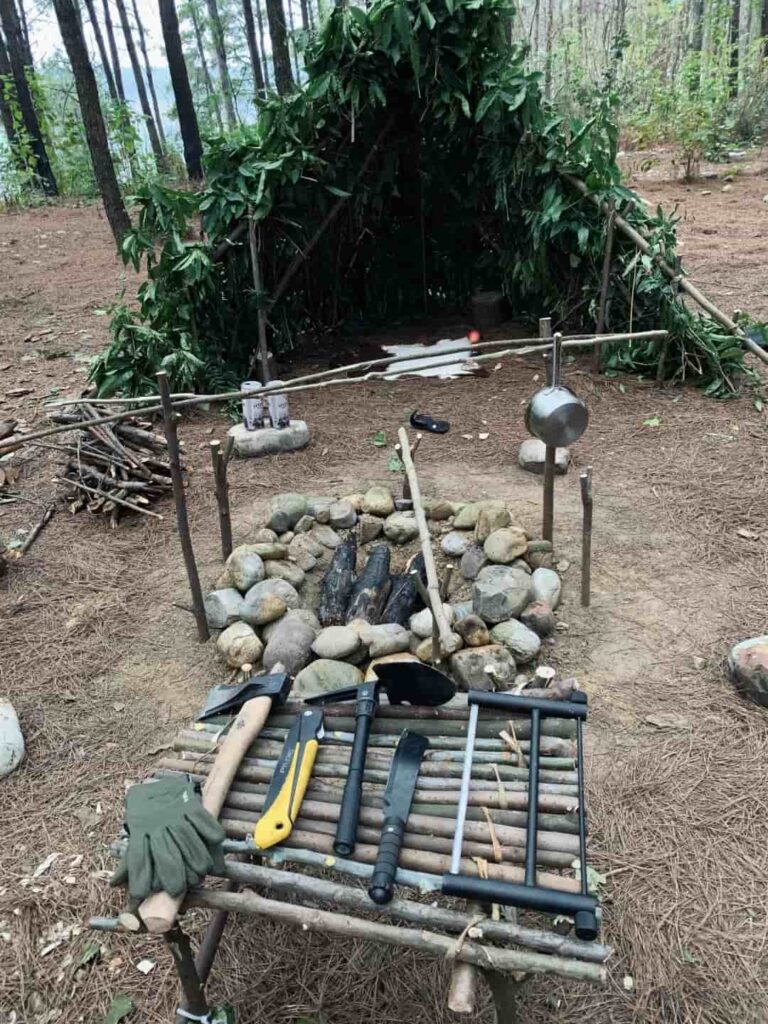
Building a shelter? Methodically lash one pole, then the next.
It feels counterintuitive when the sky is threatening rain, but a shelter built in 20 calm minutes will keep you dry.
One built in 10 frantic minutes will collapse on you at 2 a.m., and you’ll spend the remaining 10 minutes sobbing under a tarp.
2. Shift Into Observation Mode Before Acting
I used to crash into a new spot like a party guest who immediately starts rearranging the furniture.
“This is perfect! Tent here! Fire there!” I’d declare, only to realize at midnight that I’d pitched my home on the continent’s premier ant superhighway, directly under a dead branch known locally as “The Widowmaker.”
The Hack: Now, I play a game called “Statue for a Minute.” When I first stop, I literally freeze. No moving, no planning. Just sense.
- Ears: What do I hear? Birds (good), silence (animals might be hiding), a faint trickle (WATER!).
- Eyes: I scan up (deadfall, bee nests), across (animal paths, plant types, resources), down (poison ivy, slopes, soggy ground).
- Skin: Where’s the sun? Wind direction? (Pro tip: put your smoke downwind of your shelter, unless you enjoy the aroma of Eau de Campfire in your sleeping bag).
This 60-second investment is like reading the instruction manual before you break the device.
It tells you where to find water, where to build, and what dangers to avoid.
It turns you from a blind participant into the director of your own little wilderness film.
3. Break Every Challenge Into Micro-Tasks
“Build a shelter” is a overwhelming, monolithic horror. It’s the Mount Everest of to-do lists.
Staring at it induces what I call “Survival Paralysis,” where you just sit on a log, eating your last gorp, wondering if you could be adopted by a friendly bear.
The Hack: I became a master of the embarrassingly small task.
- Goal: Shelter.
- Step 1: Find two trees about 8 feet apart. (Hey, I did a thing! Go me!)
- Step 2: Find a long, straight pole for the ridge. (Look at us, we’re shelter builders!)
- Step 3: Lean some big sticks along it. (We’re basically architects!)
- Step 4: Pile on leaves. (Is that a cozy nook I see? It is!)
Each micro-task is a victory. Each victory releases a little shot of “I can do this” dopamine.
Instead of one insurmountable wall, you have a staircase.
You might be slow, but you’re always moving up.
4. Prioritize Energy, Not Tasks
My inner overachiever wanted a Pinterest-worthy camp: symmetrical fire lay, braided cordage, decorative berry garlands.
My inner survivor, a much smarter but lazier creature, eventually piped up: “You’re shivering, you haven’t drunk anything in hours, and you just spent 45 minutes carving a spoon.
You have priorities, and they are stupid.”
The Hack: The ultimate survival question is: “What gives me the biggest return on my calorie investment RIGHT NOW?”
- Calories spent building a majestic four-poster bed of pine boughs: 500. Return: Slightly comfier sleep.
- Calories spent gathering dry wood and boiling water: 300. Return: Warmth, hydration, morale, the ability to think.
Often, the right answer is rest. Yes, just sitting. Conserving energy is a task. Perfection is the enemy of the alive.
A ugly, lopsided shelter that’s done beats a perfect foundation you’re too exhausted to finish.
5. Embrace the Minimum Viable Solution
Linked to the above, this is about killing your ego. I wanted a forest mansion to Instagram.
The woods demanded a functional hole to not die in.
The Hack: Think of it as the MVP (Minimum Viable Product) of survival. What is the simplest, fastest thing that solves the core problem?
- Problem: I’m getting cold and wet.
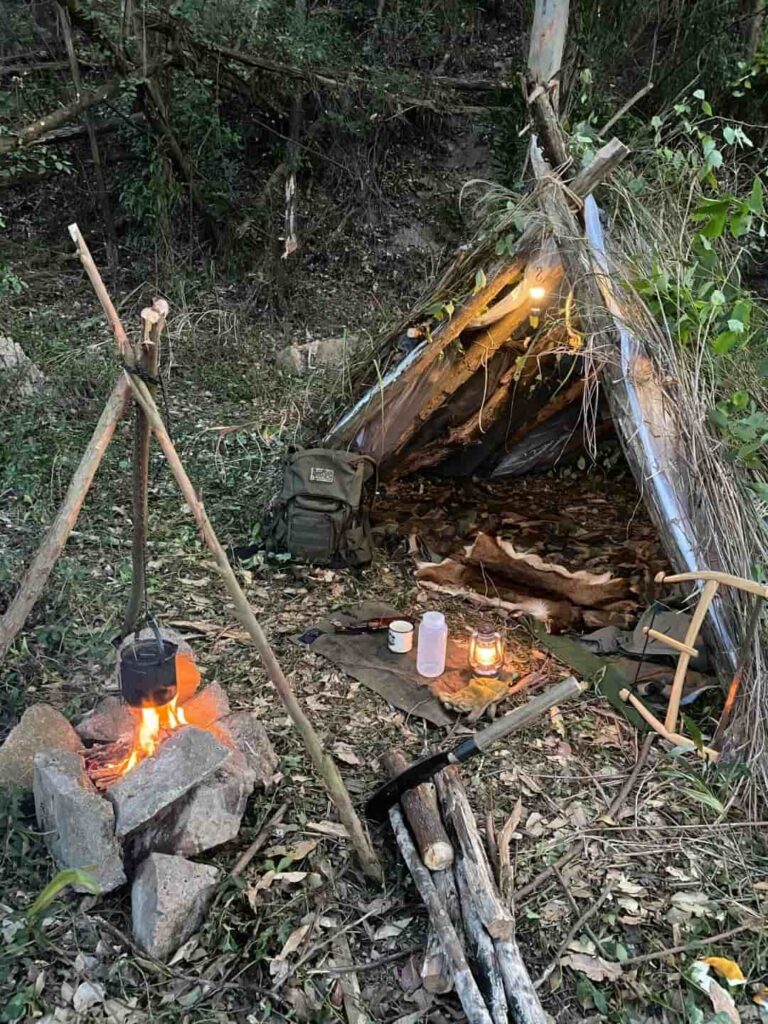
- MVP Solution: A basic lean-to of branches and a leaf trash-pile to crawl into.
- Fool’s Gold Solution: A log cabin with a door, a chimney, and a hand-carved “Welcome” sign.
The sun doesn’t care about your aesthetics. It will set. The temperature will drop. The MVP gets you to sunrise.
You can upgrade your hovel to a condo tomorrow if you have the energy.
Survival is a series of sunrises earned, not trophies built.
6. Treat Everything as a Resource
The modern brain is trained to see “stuff.” The survivor brain is trained to see potential.
I walked past a thousand resources, seeing only dirt, leaves, and weird bugs.
The Hack: It’s a mental game of “What can you be?”
- That cattail? Food, insulation, tinder, cordage.
- That fatwood stump? Nature’s lighter fluid.
- That plastic bottle washed up? Water carrier, cordage (cut into a long strip), fishing float.
- That hollow log? Instant shelter frame or a place to store gear.
You stop seeing a landscape and start seeing a hardware store, a pharmacy, and a supermarket that’s just really, really bad at labeling.
A dripping overhang isn’t an annoyance; it’s a water source. It’s the most empowering shift you can make.
7. Run a Constant Internal Risk Assessment
I was terrified of bears, cougars, and the Blair Witch. Meanwhile, the ground was a tangled mess of roots, the rocks were slick, and I was holding a knife while wearing inappropriate footwear.
I was worried about sharks while standing in a minefield.
The Hack: Narrate your own safety documentary. In a calm, David Attenborough voice in your head, note the hazards: “And here we see the human, placing its foot precariously on that moss-covered stone. A slight twist now could mean a sprained ankle, isolating it from its group and water source…”
Constantly ask: “What is the most likely thing to hurt me here?” 99.9% of the time, it’s not a predator.
It’s a slip, a cut, a fall, a stupid decision born of rushing or fear. Manage the mundane dangers, and you’ll almost certainly never meet the dramatic ones.
8. Expect Discomfort, Not Disaster
I thought if I was cold, hungry, or wet, I was failing at survival.
This led to panic. Panic leads to bad choices. Bad choices lead to being colder, hungrier, and wetter.
The Hack: Re-frame discomfort as the entry fee. You are not in your temperature-controlled house. You are in the world. The world is sometimes damp and pointy.
- “My feet are sore” = normal.
- “I’m a bit hungry” = expected.
- “This leaf bed is lumpier than my mattress” = hilarious understatement.
When you accept these as part of the package, they lose their power to scare you. You stop fighting the reality of your situation and start working within it.
Discomfort is data (“I should move more to warm up”), not a death sentence.
9. Practice the “Rule of 3 Awareness”
This is your triage system for the brain. When everything feels urgent, the Rule of 3 creates order from chaos.
The Hack: Let it guide your decisions like a bossy but brilliant coach.
- 3 minutes without air/bleeding: Is anything RIGHT NOW threatening my breathing or causing me to bleed out? No? Okay, breathe. Priority one is secured.
- 3 hours without shelter in bad conditions: Is it cold, wet, windy, or blazing hot? If yes, regulating your core temperature is your absolute next priority. Not food. Not exploring. Shelter.
- 3 days without water: Once sheltered, water is next. Always.
- 3 weeks without food: See? Food is way down the list. You can be hungry. You cannot be dead from hypothermia or dehydration.
This rule violently yanks your mind away from worrying about tomorrow’s lunch and focuses it on tonight’s survival.
10. Use Mental Anchors During Stress
When the storm hits, the fire dies, and you can’t find your cordage, the brain goes full Windows 95 error screen. Blue screen of death.
My old response was to vibrate in place making a high-pitched “eeeeeeee” sound.
The Hack: Have a pre-programmed mantra. A short, stupidly simple phrase to reboot the system. Mine is “Stop. Breathe. Smell. Listen.”
- Stop: Cease all movement. Freeze the panic.
- Breathe: Take one huge, audible breath. It forces a physiological reset.
- Smell/Listen: Engages your primal senses, pulling you out of your spinning head and back into your environment.
Another is “The Next Right Thing.” Not the whole thing. Just the next thing.
Is it putting on my jacket? Is it getting under my lean-to? Is it taking a sip of water?
Do that. Then ask again.
Final Thoughts
These mindset hacks aren’t about becoming Bear Grylls. They’re about becoming a calmer, more observant, and more strategic version of yourself.
The wilderness doesn’t care how tough you are; it cares how adaptable you are. It’s a game of chess against the elements, and these ten rules are how you keep your king (that’s you, the fragile, thirsty, bipedal king) safe.