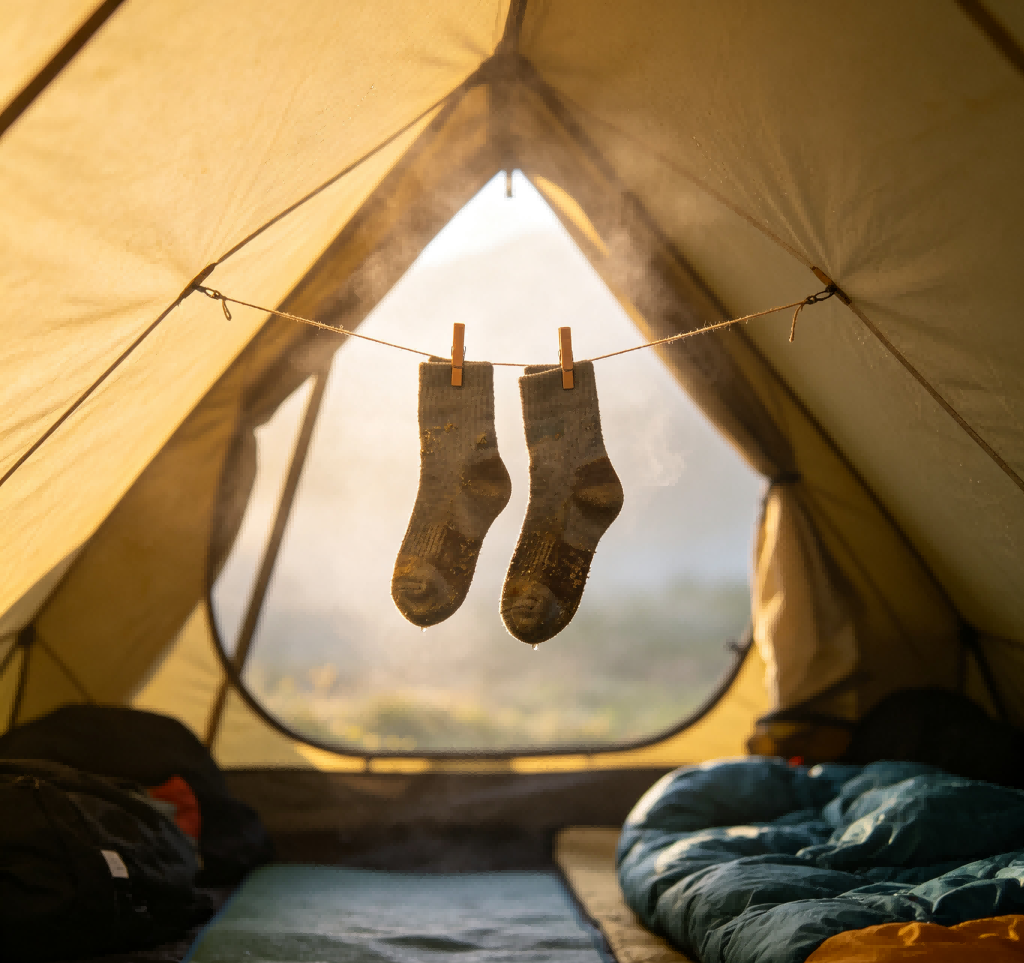
I woke up on the morning of my first serious mountain hike with a feeling of dread. It wasn’t the altitude or the distance. It was the clothing.
If you’ve ever stared into an abyss of synthetic fibers and wool blends and felt pure confusion, you’re my people. I’ve been there.
I’ve been the person wearing jeans on a hike (a crime against humanity, I know now) and the one sweating through cotton while simultaneously getting hypothermia.
But after years of trial and significant error—including a memorable incident where I had to use spare socks as gloves—I’ve developed a system.
A layering system that is less about strict rules and more about embracing glorious, logical flexibility.
We’re going to get practical, we’re going to get specific, and I’m going to share my favorite gear, all while holding onto a life-changing Norwegian proverb: “There’s no such thing as bad weather, only bad clothing.” (Spoiler alert: They are 100% correct, and they probably also invented the modern wool sock.)
We’ll break it down into the holy trinity of not-turning-into-a-popsicle: Base Layers, Mid Layers, and Outer Layers.
Let’s dive in.
Table of Contents
1. Base Layers: Your Second Skin (That Doesn’t Stink)
Think of your base layer as your own personal climate control system.
This isn’t just a fancy undershirt; this is the foundation upon which your warmth and dryness are built.
Its job is simple but critical: it lives next to your skin, wicking moisture (a fancy word for sweat) away from your body and pushing it through the fabric so it can evaporate.
A dry hiker is a happy hiker. A sweaty, clammy hiker is a miserable, shivering one who nobody wants to share a tent with.
Key Features of a Good Base Layer:
It should feel like a gentle hug from a cloud—lightweight, comfortable, and warm without being bulky.
Its entire personality is built on being moisture-wicking and quick-drying. If you sweat, it should feel like your base layer is saying, “I got this, buddy,” and then promptly gets to work.
The Great Material Debate: Wool vs. The Synthetic Upstart
This is the age-old battle in the outdoor world, and I’ve camped on both sides of the river.
• Merino Wool: The Luxury MVP
Let’s be clear, this isn’t the itchy, chunky wool of your grandmother’s Christmas sweater. Merino wool is a miracle fiber. It’s incredibly soft, provides warmth even when it’s damp (a superpower), and has wicking properties that are almost magical. But its party trick, the one that truly makes it worth the investment, is its odor resistance.
I have personally tested a Merino wool t-shirt on a week-long trek. I am not a naturally odorless person. Yet, after seven days of strenuous activity, it did not smell bad. It smelled… like a t-shirt. It’s borderline witchcraft. You can easily wear a Merino base layer for 1-2 weeks without offending your fellow adventurers.
The Catch? It’s expensive. We’re talking $60–$100 for a good top. And it needs a little TLC—delicate washing cycles and no aggressive heat drying.
My Go-To: A simple, robust wool merino t-shirt from Decathlon. It’s the perfect entry-point into the cult of Merino without having to remortgage your house.
• Polypropylene (Polypro): The Affordable Workhorse
This is the synthetic contender. It’s less expensive ($30–$40), and it wicks moisture very effectively.
Where it falls short is in the odor department. After a day or two, a Polypro top will develop a… personality. It will start to smell like a locker room that’s seen things.
Because of this, I’ve found its perfect niche: as a dedicated sleeping layer on multi-day trips. It’s cheap, warm, and you’re only subjecting your sleeping bag to its fragrant aura.
My Layering Tips & Product Parade:
• Active Layer: For any day where I’m moving and expect to sweat, I’m head-to-toe in Merino wool. My top is the Decathlon tee, and for bottoms, I swear by Odlo long johns. They’re 100% wool comfort. • Sleeping Layer: A cheap, dedicated set of Polypro long johns and a top that live exclusively in my sleeping bag stuff sack. • Mix and Match: Don’t be afraid to experiment! Sometimes, on a cool day, I’ll wear two thinner Merino t-shirts. The system is flexible. • The In-Betweener: I have a Devold 200 gsm mid-weight wool top that sometimes blurs the line between a base and a mid layer. It’s perfect for colder starts or less intense activity.
Accessories: The Finishing Touches
Your core isn’t the only thing that needs love. Socks, gloves, beanies, and buffs (or “boofs” as we call them in local slang) are all part of the base layer system. The rule here is universal: AVOID COTTON. Cotton is the enemy. It’s a sponge.
It gets wet, clings to your skin, loses all its insulating properties, and takes approximately one geologic era to dry. Wearing cotton socks on a hike is a one-way ticket to Blister City.
Alright, you’ve got your high-tech second skin sorted. Now we need to trap all that lovely body heat you’re generating.
Enter the mid layer, the insulating hero of our story. This is the warm blanket that sits between your base and outer layers, creating a cozy pocket of warm air around you.
The Spectrum: From Thrift Store Chic to Space-Age Tech
The beauty of the mid layer is its range. It can be wonderfully low-tech or gloriously technical.
• Low-Tech Glory: My absolute favorite piece of clothing in my entire wardrobe is a salvaged, gloriously garish Salewa fleece from the 1990s that I found for €25. It’s thick, it’s a hideous shade of teal, and it works perfectly. A classic fleece or a sturdy flannel shirt are phenomenal, affordable, and often character-filled mid layers.
• High-Tech Options: This is where you get into insulated jackets filled with down or synthetic insulation (Primaloft, etc.). For high-intensity activities where you might sweat a lot (like ski touring or fast-packing), I lean towards synthetic. My favorite is the Montbell Therm Wrap UL—it’s insanely lightweight, breathable, and packs down to the size of a grapefruit.
◦ Pros: Handles moisture like a champ. If it gets wet from sweat or a light shower, it will still keep you warm and dries out quickly. The technology is continually improving, making it lighter and more packable every year.
◦ Cons: It’s generally slightly bulkier than down for the same warmth, and it will lose its insulating ability over many years as the fibers break down.
• Down Insulation: The High-Maintenance Supermodel
◦ Pros: Unbeatable warmth-to-weight ratio. It’s lighter and packs smaller than any synthetic. The loft (fluffiness) is superior, creating more heat-trapping air pockets.
◦ Cons: It has a mortal enemy: moisture. Once down gets wet, it clumps together, loses all its loft, and becomes a cold, sad, expensive lump. It’s also pricier. A crucial ethical note: Always look for Responsible Down Standard (RDS) or similar certification to ensure the down is a by-product of the food industry and that live-plucking didn’t occur.
Your mid layer is your most adjustable variable. Standing around at a windy summit?
Bust out the puffy down jacket. Hiking uphill in the sun with a pack?
Maybe just the trusty old fleece. Listen to your body.
If you’re starting to sweat, the mid layer is the first thing to come off.
For active use in the mountains, you usually don’t need a mid layer for your legs.
Your circulation is focused on your core, and your legs generate a lot of heat.
A good pair of soft shell pants (which we’ll get to) is almost always sufficient.
I only break out hard shell pants or expedition-weight base layers for sitting still in very cold conditions or for dealing with wet snow and prolonged, brutal exposure.
This is it. The final boss of your wardrobe. The most technical, and often most expensive, part of your kit.
Your outer layer’s purpose is simple but brutal: to keep you dry from external water (rain, snow) and to block the wind. It is your fortress against the elements.
When shopping for a hardshell jacket, don’t just look for “waterproof.” Look for:
• Waterproof & Breathable Membrane: This is the magic inside the fabric. Gore-Tex is the famous one, but there are many other excellent ones.
• Pockets, and More Pockets: You need places to stash gloves, snacks, your phone, and your sense of existential dread when the weather turns.
• A Helmet-Compatible Hood: This is non-negotiable if you do any climbing or skiing. It should be adjustable and move with your head.
• Pit Zips: These are massive zippers under the armpits. Think of them as emergency exhaust vents for when you’re working hard. They are a game-changer for temperature regulation.
When to Deploy the Shield:
• Soft Shell Pants: For 95% of my mountain days, these are what I wear. They’re stretchy, breathable, water-resistant, and durable. They are the perfect active pant.
• Hard Shell Pants: These stay in my pack unless I expect truly awful conditions: heavy, wet snow, driving rain, or prolonged exposure to harsh wind. They are your emergency barrier.
The Golden Rule of Layering Compatibility:
Avoid jackets that try to be a “mid and outer layer hybrid.” You want a system where you can wear all three layers at once in extreme conditions without looking like a overstuffed sausage.
Your outer shell should be roomy enough to fit over your bulkiest mid layer. Test this at home before you’re on a mountain in a whiteout.
4. The Grand Unified Theory of Layering (A.K.A. My Principles)
So, let’s synthesize all this madness into a few core principles:
1. Base Layers are Personal: Use multiple if needed. Lean on wool for activity and cheap synthetics for sleeping. Keep your skin dry at all costs.
2. Mid Layers are Flexible: Your insulation is your thermostat. Have a range, from a simple fleece to a technical synthetic or down jacket. Remember, your legs usually don’t need this level of pampering.
3. The Outer Layer is Your Shield: This is your most critical piece of safety gear for bad weather. Don’t cheap out, and make sure it fits over everything else.
4. Adapt, Adapt, Adapt: Your clothing should be as dynamic as the mountain weather. Stop to add a layer before you get cold. Take a layer off before you start sweating buckets. Your comfort is a continuous process of minor adjustments.
5. There Are No Strict Rules: This system is a framework, not a prison. You learn what works for your body through experience.
Conclusion
When I finally sorted my layering system, everything changed. The mountains stopped being a place I had to endure and became a place I could enjoy, regardless of what the sky threw at me.
The confidence that comes from knowing you’re prepared is worth every penny and every bit of over-analyzation.
The best advice I can give you is this: forget the books and the endless online reviews (except this one, obviously).
Get out there and experiment. Get a little cold, figure out what you needed. Get a little sweaty, learn to vent sooner. Your personal layering system is just that—personal.
It’s a kit built on experience, on mistakes, and on the glorious freedom of being perfectly comfortable while everyone else is huddling in the wind.
I’d love to hear about your own layering wins and disasters! What’s your go-to piece of gear? What’s the biggest mistake you’ve ever made? Throw your questions and stories in the comments below.
Now, if you’ll excuse me, there’s a mountain calling my name.
See you on the summit!