Let’s have a little chat. If you’re getting ready for a backpacking trip, you are almost certainly packing way, way too many clothes.
The most common reactions are:
• “What if it gets cold?”
• “What if it gets wet?”
• “But… what do you wear?”
I get it. Everyone has their personal comfort preferences. Some of us are sun-worshippers, others are reptilian and require external heat sources.
And through it all, I’ve discovered a beautiful, almost magical secret: I carry roughly the same amount of clothes whether I’m heading out for a weekend or for four to six months.
The answer lies in a simple, trail-proven concept: hikers pack their fears.
We are a species terrified of being cold, wet, or generally uncomfortable. So we stuff our packs with “just-in-case” items, creating a security-blanket-on-our-back that weighs more than a small child.
The result? A pack so heavy you need a sherpa just to get to the first switchback.
Well, friends, we are entering what I like to call “gear-share season.”
And I feel motivated to share the one system I’ve perfected over a decade: a reliable, adaptable, and laughably simple layering system that works anywhere, anytime.
Table of Contents
1. The Layering System: Your Personal Temperature Dial
My entire clothing philosophy boils down to this: every single item I carry is designed to work with another.
It’s a sartorial symphony, a textile tango. The goal isn’t to have a specific outfit for every possible microclimate; it’s to have a set of layers that you can mix, match, and peel off to easily adjust your body temperature.
You want to avoid the two great evils of hiking: becoming a sweaty, overheated mess, or turning into a shivering, hypothermic popsicle.
The system is built on five simple pillars:
• The Base Layer: Your everyday, all-day hiking uniform.
• The Chilly Layer: For when the air gets crisp and the coffee isn’t enough.
• The Rain Layer: For when the sky decides to cry on your parade.
• The Cold Layer: For when you need to impersonate a walking sleeping bag.
• The Sleep System: For pretending you’re a clean, civilized human at night.
Simple, right? Let’s break it down, starting with the foundation of it all.
2. The Base Layer: Your Second Skin (That You Never Wash)
This is what you’ll be wearing about 90% of your waking hours. It’s the clothing you hike in, sweat in, and build a… rich personal aroma… in.
Its primary function is versatility and comfort, with a heavy emphasis on “doesn’t hold smells too badly.”
Nine times out of ten, my legs are clad in shorts. I’m a devout member of the Church of Unrestricted Leg Movement.
My current holy text is the Patagonia Strider Pro running shorts. They’re ridiculously light, dry faster than you can say “unexpected stream crossing,” and have a built-in liner that eliminates the need for separate underwear (a true weight-saving pro-tip).
They also have these glorious side pockets that are perfect for a phone, a snack, or my personal hiking companion, a set of earbuds for those long, mindless climbs.
They’re so comfortable and presentable that I’ll often wear them into town for a resupply, proudly displaying my grimy, trail-toned gams for all the civilized world to see. Do I ever wear pants? Sure. In subzero temperatures or if I’m doing some serious mountaineering where I need to protect my legs from rock and ice.
But for 99% of my hiking, it’s shorts. I’ve hiked in shorts in conditions that would make a Yeti reach for long johns. Hiking in pants, for me, feels like being in a stuffy, fabric-walled prison.
B. Top: The Sun Hoodie Supremacy
I used to be a button-up hiking shirt guy. You know the type—long sleeves, a collar to protect the neck, looking like a slightly lost safari guide. I’ve seen the light, and it is the sun hoodie.
My current favorite is the Evolv Supply Co Mirage Merino Sun Hoodie (full disclosure, it’s my own design, but I designed it because nothing else was perfect). Why is it so great? It’s the multi-tool of hiking tops. The sleeves protect my arms and, in a pinch, my hands.
The hood protects my face, ears, and neck from the sun, eliminating the need for a separate hat or neck gaiter during the day.
It’s made from Merino wool, which is basically magic spider-silk from sheep. It regulates temperature, wicks moisture, dries reasonably fast, and—its party trick—it doesn’t stink!
You can wear it for days, and while you might smell like a goat, the shirt will just smell like… well, a slightly musky sheep.
It’s a noticeable improvement. The front zipper lets me dump heat on a climb, making temperature control a breeze. It simplifies everything.
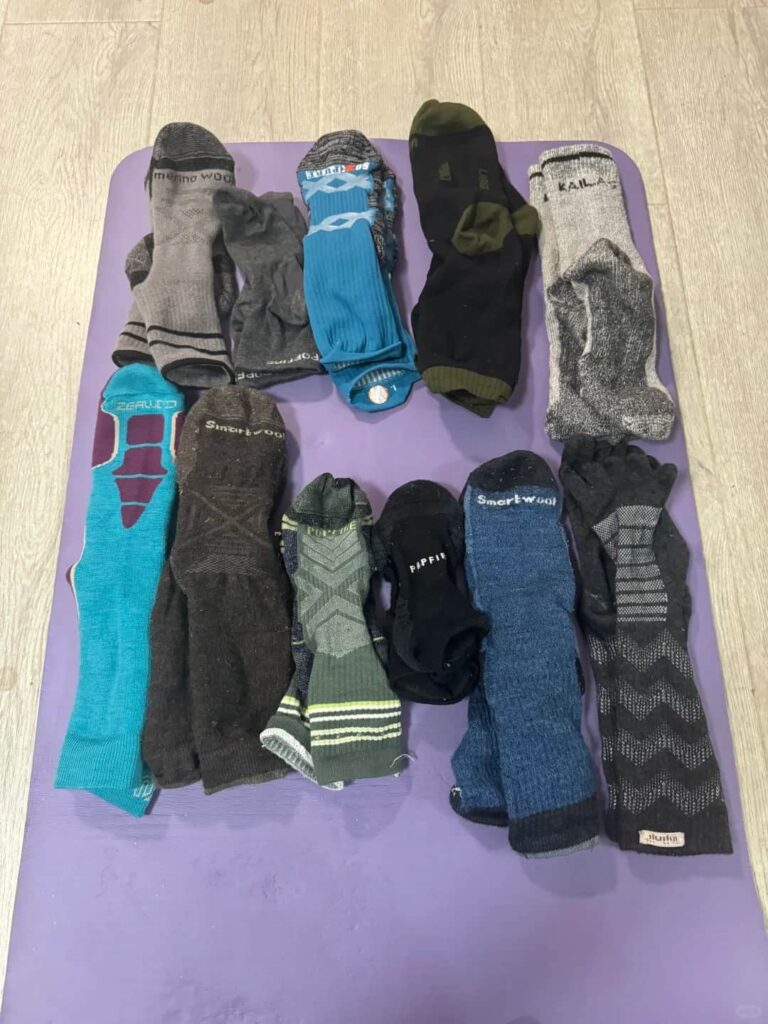
The same gospel of Merino wool applies to my feet. I wear Merino wool socks exclusively. They dry quickly, they keep your feet warm even when they’re wet (a minor miracle), and they help regulate temperature.
They are the unsung heroes that stand between you and a blister-filled nightmare.
D. The Buff: The Swiss Army Knife of Neckwear
I always, always carry a Merino wool buff. This simple tube of fabric is worth its weight in gold.
It’s a neck gaiter, a face mask in cold wind, a beanie for my ears, and an impromptu hat. It’s the accessory that says, “I’m prepared, but I’m also too lazy to pack dedicated items for all these body parts.”
E. The Minimalism Mindset: Embrace the Filth
Here’s the part that separates the day-hikers from the thru-hikers. I do not carry extra hiking clothes. No spare shorts. No spare shirt. No “rotation.” I can feel your shudder from here. “But what about when they get dirty?”
My friend, let me impart some profound wisdom: your clothes get dirty because your body is dirty. There is zero logical point in taking off your dirty, sweaty shirt, and putting on a “clean” one over your dirty, sweaty body. All you’ve done is create two dirty shirts and added weight to your pack.
The solution? Embrace the grime. You are one with the trail. You smell of pine, earth, and effort. It’s the perfume of adventure.
You and your clothes are a unified, slightly fragrant entity until you reach a town with a washing machine (or a river with a strong current and a biodegradable soap).
Then, and only then, do you clean both your body and your clothes in a glorious, simultaneous ritual of purification. This mindset saves pounds and frees your mind from the tyranny of false cleanliness.
3. The Chilly Layer: For When Your Coffee Wears Off
This is the layer for those crisp mornings, the evenings when the sun dips, and the elevation gains where the air gets thin and cold.
The focus here is on lightweight, breathable insulation, specifically keeping your core warm.
My go-to is an Alpha Direct fleece. This stuff is genius. It’s incredibly warm for its weight, but it’s also wildly breathable.
This means you can wear it while you’re moving and not immediately turn into a walking sauna. It provides what’s called “active insulation”—it keeps you warm while you’re generating heat.
I usually carry one of these, either a super-lightweight version or a slightly more robust, paneled one for colder trips.
For true subzero or mountaineering, I might swap it for a beefier micro-grid fleece. But there is always a fleece in my pack.
It’s the perfect item to “fill the space” and be ready for an unexpected temperature drop.
Yes, more Merino wool. I carry a pair of Merino tights. Their uses are manifold:
• I can wear them under my shorts in cold rain. • I can let them get wet because my body heat will dry them out as I hike. • In a real pinch, I can wear them under my shorts in the morning and—voila!—I have makeshift pants without the weight or bulk of actual pants.
As an optional add-on, I sometimes bring ultralight wind pants. They weigh next to nothing and provide an amazing extra barrier against wind and bugs, often making the tights feel even warmer.
I’ve carried the same pair of lightweight gloves for years. They’re not heavy-duty ski gloves; they’re just enough to take the bite out of a cold morning or keep my fingers functional while setting up camp in the evening.
For all but the most extreme cold, they are perfect. For mountaineering, I’ll upgrade to something more substantial, but the principle remains: keep it light.
4. The Rain Layer: Your Personal Heat-Trapping Forcefield
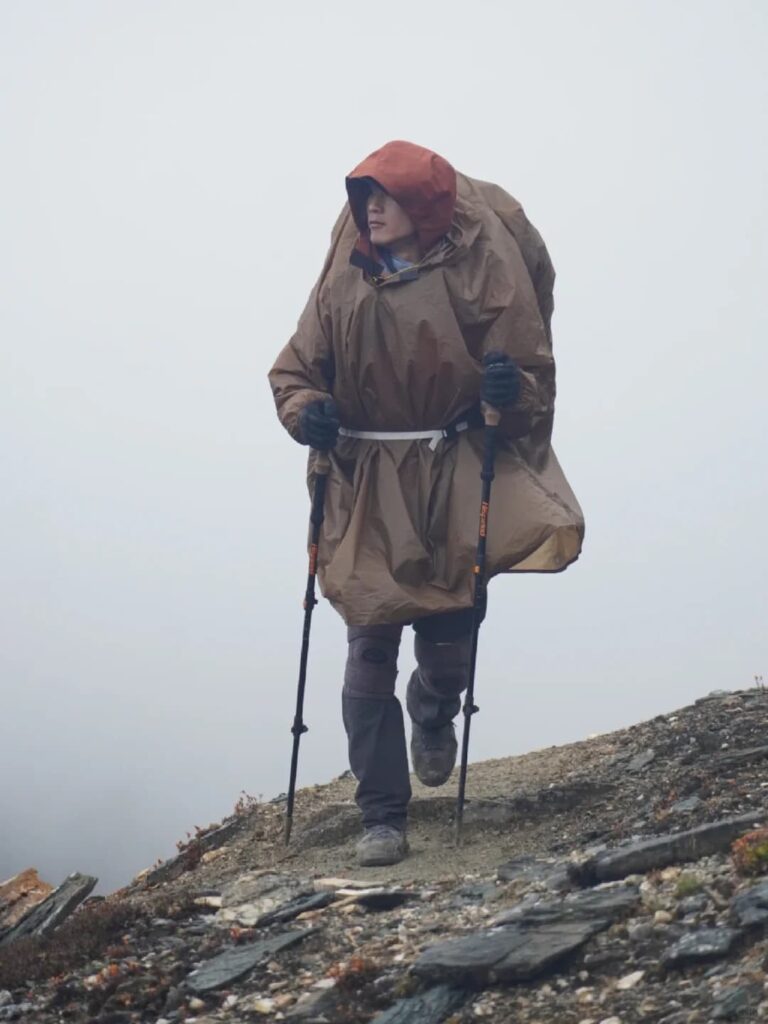
This is non-negotiable. Always bring a rain jacket. I don’t care if you’re hiking in the Sahara. I don’t care if the forecast is 100% sunshine for the next century. Bring it.
Ultralight ones pack down to the size of a soda can, and their utility is immense.
Here’s the most important mindset shift about rain gear: A rain jacket’s primary job is not to keep you dry.
Let that sink in. In a sustained downpour, especially if you’re active, you will get wet.
Either from sweat on the inside or from the jacket eventually “wetting out” on the outside.
The real, glorious function of a rain jacket is to trap your body heat and act as a fantastic, windproof warm layer.
My typical use case? It starts raining. I put the jacket on. It blocks the wind and the initial wetness.
As I hike, my body heat creates a warm, humid microclimate inside the jacket. I’m damp, but I’m warm and damp, which is a world of difference from being cold and wet.
It often goes directly over my base layer, or if it’s really cold, over my fleece. It’s the ultimate outer shell.
5. The Cold Layer: For When You’re Not Moving Anymore
This is your “Oh crap, it’s actually freezing” or “I’m at camp and my internal furnace has shut down” layer. The star of the show here is the puffy jacket. My main squeeze is synthetic puffy.
Why synthetic? Because it keeps you warm even when it’s wet. Down is amazing until it gets damp and loses all its loft, turning into a sad, flat, cold-feathered pancake.
Synthetic insulation? It just shrugs and says, “A little moisture? No problem.” I almost never hike in my puffy. It’s for camp wear, for cold mornings while I’m packing up, or for sitting around enjoying the view without turning into an icicle.
This is where the layering system truly shines. Let’s say it’s brutally cold. I become a walking lasagna of warmth.
6. The Sleep Layer: The Great Lie of Cleanliness
This is the one concession to civility. The purpose of the sleep layer is to create a clean-ish barrier between your filthy, trail-grimed body and your nice, expensive sleeping quilt.
It’s a psychological trick as much as a practical one.
It keeps the bulk of your daily grime and sweat off your sleeping bag, which helps maintain the loft of your insulation. It’s a tiny luxury with a big payoff.
B. The Beanie
A simple, lightweight knit hat. It’s crucial for camp and sleep, as you lose a ton of heat through your head. I’ve also been known to wear it on trail during particularly cold, windy stretches at elevation. It’s cozy, it’s light, and it makes you look like a serious, thoughtful adventurer, even if you’re just thinking about mashed potatoes.
C. The Extra Socks
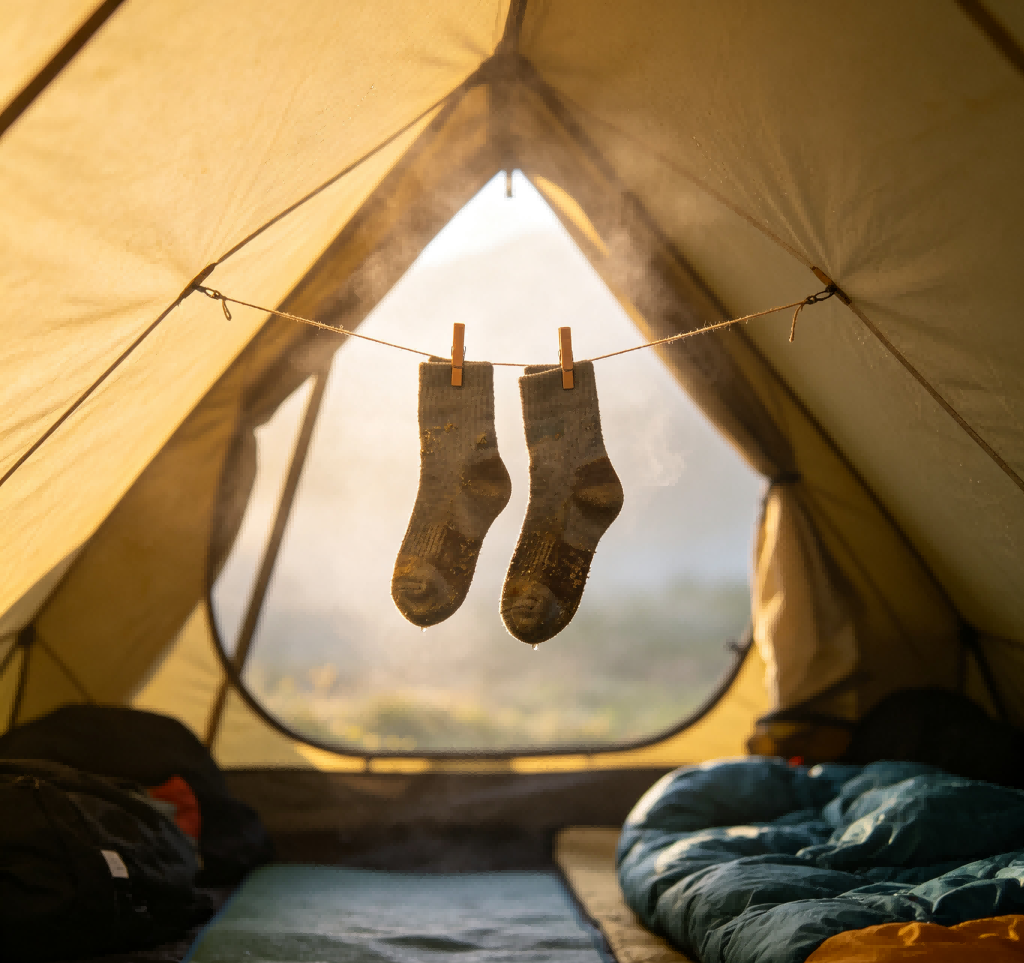
I carry one—exactly one—extra pair of socks. Their sole purpose (pun intended) is to be swapped with my dirty pair at camp. I let my hiking socks air out (or if it’s sunny, strap them to the outside of my pack to dry/bake), and I slip into the clean, dry pair. This simple rotation does wonders for preventing blisters and hot spots and makes your feet feel like they’ve been given a new lease on life.
7. Exceptions and Variations (Because I’m Not a Total Zealot)
Is this system perfectly rigid? Of course not. It’s a framework.
For sustained, bitter cold, I might swap my thin Merino tights for a heavier pair. If I’m heading into a known subzero environment from the start, I might actually start with pants instead of shorts.
The wind pants might become a permanent fixture.
But the core concept remains. The system doesn’t change. I’m just tweaking the components within the same, reliable framework.
The Grand Summary: My Entire Wardrobe in a Nutshell
So, for the tl;dr crowd, here is the entirety of my clothing system for a multi-month trek:
• Base Layer: Shorts, Sun Hoodie, Socks, Buff. (Worn 90% of the time).
• Chilly Layer: Fleece Jacket, Merino Tights, Light Gloves.
• Rain Layer: Rain Jacket.
• Cold Layer: Synthetic Puffy Jacket, Beanie.
• Sleep Layer: Sleep Shirt, One Extra Pair of Socks.
That’s it. Every piece has a purpose, and most have multiple. They all work together in a beautiful, temperature-regulating dance.
This exact list has kept me comfortable, safe, and happy from the scorching deserts of Southern California to the blustery peaks of the Presidential Range in New Hampshire.
Parting Wisdom: Your Fear is Weighing You Down
This system is universal. It works for a two-day trip in your local state park and a four-month thru-hike of a National Scenic Trail. The flexibility and simplicity are the keys.
But here’s the most important part: every hiker is different. Your body runs hot, mine runs cold (or vice versa).
This system is my gospel, but it doesn’t have to be yours. Use it as a starting point. Experiment.
Go on a shakedown hike and see what you actually use. You’ll be amazed at what you can leave behind.
Pack your fears for a trip or two, and then honestly ask yourself: “Did I use this? Or was I just afraid I might need it?”
You’ll quickly learn that the fear of discomfort is often heavier than the item itself. Shedding that weight—both physical and mental—is one of the most liberating feelings in the world.