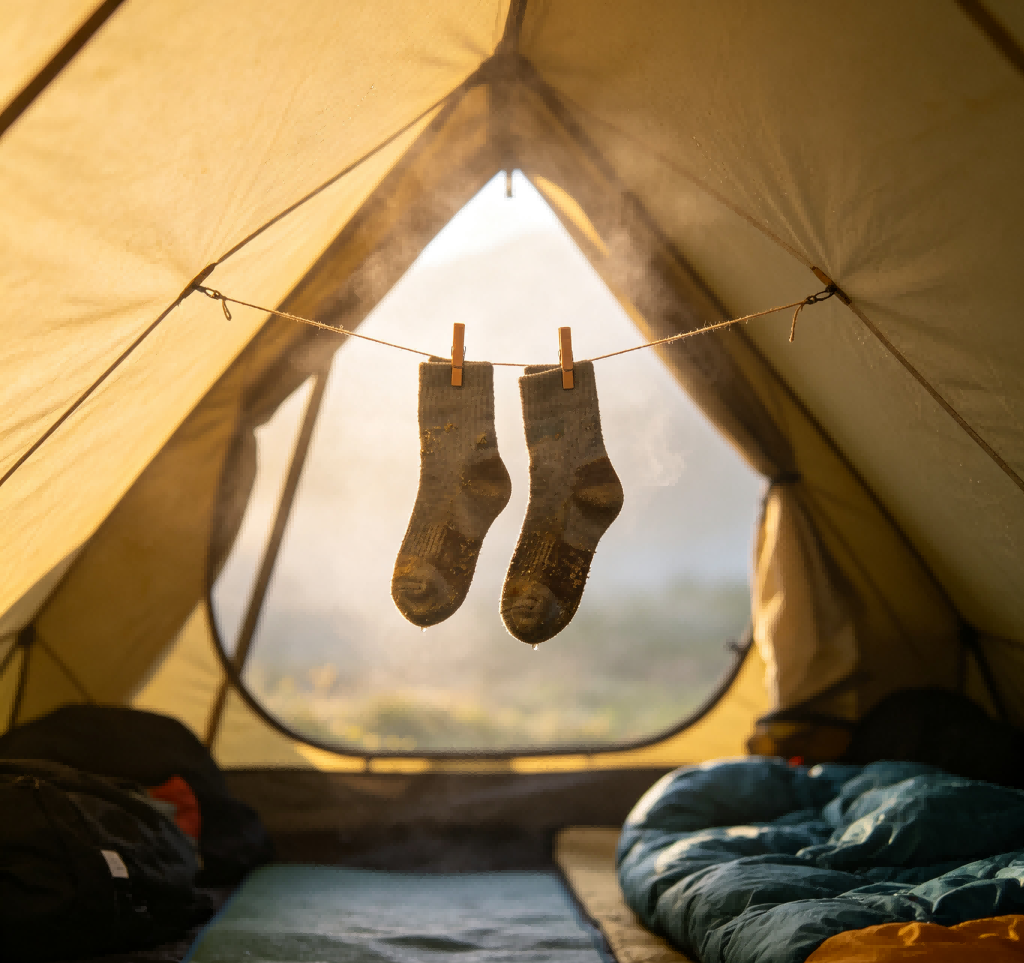
While you were dreaming of summit views, the night sky was playing a cruel trick on your gear. Temperature shifts and ambient humidity conspired against you. They turned your sturdy, reliable footwear into a soggy, uninviting mess.
It is a silent crime scene. The evidence is cold and wet.
Most hikers accept this as a fact of life. They think damp boots are just part of the outdoor experience. They are wrong.
There is a better way. You don’t need a fancy gadget. You don’t need a heated locker. You just need to understand a tiny bit of science and change where you put your stuff at night.
Table of Contents
The Science of Condensation and the "Dew Point"

Let’s get a little nerdy for a moment. Don’t worry, there won’t be a quiz later.
Air is a sneaky little thief. It holds water. You cannot see it, but it is there. Warm air is especially greedy. It can hold a lot more moisture than cold air.
During the day, your tent or the air around your campsite is warm. It is happily carrying all that invisible water vapor. Then the sun goes down.
The temperature drops. The air gets colder. It starts to lose its grip.
Eventually, the air gets so cold that it cannot hold its water any longer. It hits its limit. This limit is called the “Dew Point.”
When the air hits this point, it panics. It has to get rid of the water. It starts dumping it onto the nearest solid surface.
Your tent fly. Your sleeping bag. Your camp chair.
And yes, your boots.
The moisture turns from a gas into a liquid. This is condensation. It is the same reason a cold soda can sweats on a hot day. The can isn’t leaking. The air is just giving up.
Now, if your boots are just sitting out in the open, they become a perfect landing strip for this panicked water. The cold leather or synthetic fabric chills quickly. The warm, moist air touches the cold surface and immediately releases its liquid.
Suddenly, your boots are soaked. Not from a puddle. Not from rain. Just from the air throwing a temper tantrum.
Understanding this is step one. You cannot stop the dew point. It is a law of physics. But you can stop your boots from being the victim.
Why Interior Storage Can Be Counterproductive

So, what is the natural human reaction to this problem?
“Oh no! My stuff is getting wet from the outside air! I must bring it inside the tent to protect it!”
It makes sense. It feels safe. It is, unfortunately, often wrong.
You drag those damp boots into your cozy little nylon home. You tuck them in a corner. Maybe you even put them in a stuff sack at the foot of your sleeping bag. You think you are being smart.
In reality, you just created a science experiment.
Your tent is full of warm, moist air. You are breathing it out all night. Your body is radiating heat and moisture. It is a humid jungle in there.
By trapping your wet boots inside, you have sealed them in a sauna. They cannot breathe. The water from the boots has nowhere to go. It just hangs out.
This is the “sauna effect.”
Instead of drying, the moisture just redistributes. It soaks deeper into the lining. It seeps into the insole. It creates a perfectly warm, dark, and wet environment.
And what loves warm, dark, and wet environments?
Bacteria. Lots and lots of bacteria.
You aren’t drying your boots. You are marinating them. You are essentially putting them in a Ziploc bag with a warm, moist paper towel and letting them stew for eight hours.
By morning, they haven’t just retained the old moisture. They have potentially absorbed new moisture from your breath and body.
It feels protective. It feels logical. But it is the fastest way to turn your footwear into a science project that smells like regret.
The Benefits of "Under Cover" External Storage

So, if the inside of the tent is a bad idea, what is the answer?
You need the Goldilocks zone. Not too exposed, not too trapped.
You need the porch. The vestibule. The lean-to.
Most modern tents have them. They are that little flap of fabric outside your main door. It is the designated mudroom of the camping world. It is time to use it properly.
This area is a magical middle ground.
First, it provides a physical barrier. It stops the direct rain. It blocks the heavy, falling dew. If the sky decides to actually cry, your boots won’t drown.
But, and this is the crucial part, it is not sealed.
It is open to the air. It has a gap between the ground and the fly. It allows for maximum airflow.
Airflow is your new best friend. You want the breeze to flow over and through your boots.
You want the moisture to have an escape route.
When you place your boots in the vestibule, you are letting the air do the work. The ambient air might be humid, but it is moving. Moving air carries moisture away.
It is the difference between hanging a wet towel in a sealed bathroom and hanging it outside on a breezy day.
You are giving the water a chance to evaporate. You are breaking the cycle of saturation.
Your boots are outside the humidity bubble of your breath. They are safe from direct precipitation.
They are free to breathe. It is the perfect night shelter for weary footwear.
Protecting the Structural Integrity of the Boot

Let’s talk about money. Hiking boots are not cheap.
You probably dropped a decent chunk of change on your footwear. You want them to last. You want them to support your feet for miles and miles.
Constant moisture saturation is the enemy of longevity.
Think about how a boot is held together. There is stitching. There are high-tech adhesives. There is glue.
Water attacks these things. It weakens the glue. It causes the stitching to swell and stretch. It makes the threads brittle over time.
Every time you let your boots stay wet all night, you are inviting the water to seep into these critical joints.
The water works its way into the seams. It loosens the bond between the sole and the upper.
Then you wake up. You cram your foot into the wet boot. You walk. The water inside acts like a lubricant.
It encourages the materials to shift and grind against each other.
Eventually, the glue gives up. The stitches break. You get the dreaded sole separation. The boot starts “sucking the pacifier,” where the sole flaps open like a hungry mouth.
Leather also suffers. Good leather is durable, but it needs care. Constant wetting and drying (without proper cleaning) strips the natural oils.
It causes the leather to dry out and crack. It becomes stiff and uncomfortable.
By storing your boots in a ventilated, covered space, you are letting them dry naturally. You are reducing the time they spend saturated.
You are giving the adhesives a break.
Proper ventilation extends the life of the product. It saves you money. It means you don’t have to break in a new pair of boots next season.
You are protecting your investment, one breezy night at a time.
The Hygiene Factor: Preventing Mold and Odors

We have to talk about the smell. You know the one.
That funky, sour, “I-have-made-a-terrible-mistake” odor that emanates from gear that has been sealed up wet. It is the smell of bacterial reproduction. It is the smell of regret.
Mold and bacteria are opportunistic little jerks. They don’t ask for much. They just need moisture, darkness, and still air.
Guess what your tent interior provides when your boots are in there? A five-star resort for microbes.
Your feet sweat. A lot. Those boots are full of dead skin cells and salt. It is a buffet for bacteria. When you trap that moist, salty interior in a dark tent, the bacteria throw a party.
They reproduce. They multiply. They create that awful smell.
Mold is even worse. Mold spores are everywhere. They are just waiting for a damp spot to land on. The inside of a constantly damp boot is a mold magnet. Once mold takes hold, it is hard to kill. It breaks down the fabric. It can cause skin irritation. It is just gross.
Now, imagine storing those same boots under the vestibule.
Air is moving through them. The moisture is evaporating. The environment is not stable enough for a bacterial rave. It is too breezy. The party gets shut down.
The mold spores might land, but they can’t get comfortable. They can’t find the sustained moisture they need to grow roots.
By simply moving your boots outside the tent, you are practicing good hygiene. You are keeping the interior of your boots drier.
You are stopping the funk before it starts.
Your feet will thank you. Your tent will thank you. Your camping neighbors will definitely thank you.
Strategic Positioning for the Morning Transition
Okay, you are sold on the vestibule idea. Good for you. But you cannot just chuck your boots out there any old way. Placement matters.
You need a strategy for the morning.
The ground is cold. The ground is damp. The ground is also crawling with critters who might see your boot as a potential new home. (Nobody wants to find a spider in their toe box at 5 AM. Trust me.)
Elevation is key.
Do not put your boots directly on the dirt. The ground wicks moisture. It is cold. It will suck the warmth right out of them.
Find a rock. Find a stick. Find a spare stuff sack. Put your boots on top of something. You want air to flow under them as well as over them.
If you have a pack, put the boots on top of the pack. If you have a plastic bag, lay it down first. Just get them off the cold, wet floor.
Next, think about wind direction. Which way is the breeze coming from? Point the opening of the boots away from the wind.
You don’t want leaves and dirt blowing directly into them. You want the air to flow around, not funnel debris inside.
Also, watch out for tall grass. Grass holds dew like a sponge. If your boots are nestled in grass, they will get wet from the vegetation itself.
Keep them in a clear, open spot under the fly.
Finally, check your laces. Tuck them inside the boot. If they hang out, they will act like wicks. They will draw moisture from the air or ground straight into the boot.
In the morning, you will reach out. You will grab a boot that is cool, but dry. You will slip your foot in. It will be crisp. It will be comfortable.
You will start your day ahead of the game. All because you placed them on a rock, off the ground, in the breeze.
Conclusion
It is a small change. It takes ten seconds of effort before you crawl into your sleeping bag.
But that tiny habit changes everything.
You stop fighting the dew point. You stop marinating your gear in a tent sauna. You let the night air do the job it was meant to do: circulate and evaporate.
Dry boots mean happy feet. Happy feet mean no blisters. No blisters mean you hike farther and smile more.
Your boots will last longer. They will smell better. They will be ready to go when you are.
So tonight, when the temperature drops and the air starts to sweat, don’t hide your boots in the dark. Give them a spot on the porch. Let them breathe.
Your morning self will thank you. Your feet will definitely thank you. Now go enjoy the trail.