Our ancestors were absolute units. They plowed fields with their bare hands, hunted dinner with a pointy stick, and probably fought off a bear before breakfast just to get the blood flowing.
They built empires and crossed oceans in wooden tubs.
And me? I once had a minor existential crisis because my Wi-Fi was down for ten minutes. I consider “hunting” to be successfully navigating the grocery store aisles to find the last tub of artisanal hummus.
My idea of “shelter” involves a thermostat set to a perfect 72 degrees.
We are the soft, pampered descendants of giants. But deep down, under layers of comfortable complacency and a dependence on food delivery apps, that primal spark still flickers.
It’s the part of you that looks at a storm cloud and thinks, “Huh, I should probably know how not to die in that.”
This blog post is for that spark. We’re not going full Bear Grylls.
This is a beginner’s guide to some survival skills, using cheap, modern tools you can stuff in a backpack.
Table of Contents
1. Shelter: Your Adult Blanket Fort
Your number one priority, before you even think about whining that you’re thirsty, is to get a roof over your head.
Hypothermia doesn’t care about your feelings, and it will end you in a shockingly short amount of time.
A. Materials & Prep: The Tarp is Your God
Poncho/tarp: Go to any army surplus store and buy the cheapest, crinkliest, olive-drab poncho you can find.
This single piece of nylon is more versatile than a Swiss Army knife owned by MacGyver. It’s a raincoat, a water collector, a ground cloth, and, most importantly, your roof.
Don’t get fancy. Military-grade means “idiot-proof,” and we are the target demographic.
Safety Check: Before you start tying your fancy new tarp to a tree, look up. I mean, really look up.
Are there dead branches poised like nature’s daggers, waiting for a gust of wind to send them crashing through your skull? This is called a “widowmaker” for a reason that should be painfully obvious.
Find a healthy, living tree. Your future self will thank you for not being impaled in your sleep.
Paracord Setup: You don’t need a million feet of rope. Cut your paracord into 5-10 foot lengths. Learn the clove hitch.
This is the only knot you absolutely need to know for shelter. It’s adjustable, it grips like an angry lobster, and it’s easy to untie.
Practice it on a chair leg until you can do it with your eyes closed. For organization, don’t just stuff the rope into a tangled ball of regret.
Look up the “chain sinnet” or “daisy chain” method. It keeps your cordage compact and, more importantly, tangle-free. It’s profoundly satisfying.
B. Building the Shelter: The No-Sweat A-Frame
• Elevated vs. Ground-Level: If it’s warm, you want your shelter elevated to let the breeze flow through and discourage creepy crawlies from using you as a warm mattress.
If it’s cold, you want it lower to the ground to trap your body heat. Think of it as climate control for cavemen.
The “Oh Crap, I Ripped the Grommet” Fix: You’ve tied your perfect clove hitch, you pull the line taut, and RRRIP—the cheap metal grommet tears right out of the tarp.
Panic? Never. The slip-knot and button method is your savior.
Find a smooth, roundish stone. Place it on the inside of the tarp corner, poking it out like a nipple.
Now, take your paracord, wrap a slip-knot around the fabric just below the stone, and pull tight. Congratulations, you’ve just created a stronger, field-expedient grommet. You’re a genius.
Ground Prep: Once your roof is up, look down. Are you about to sleep on a bed of pointy rocks and angry ants? Clear that debris.
Kick away sticks and stones. Do a quick visual for ant hills or snake holes (a pro tip: they don’t want to cuddle).
Then, gather a huge pile of dry leaves, pine needles, or ferns. Pile them up a good foot deep inside your shelter.
This isn’t just for comfort; it’s crucial insulation from the cold, damp ground, which will suck the heat from your body faster than a tax audit sucks the joy from your soul.
2. Water: Don't Be a Giardia Statistic
You can live for weeks without food, but only about three days without water.
And dehydration will make you stupid long before it kills you.
Your number one goal is to find and purify water without giving yourself a souvenir case of explosive intestinal distress.
A. Finding Water
Prioritize clear, running water from a spring or a stream. But if the sun is going down and your only option is a murky, frog-infested puddle, you take it.
Filtering dirty water is better than dying of dehydration with clean principles.
B. Modern Filtration Methods:
The Gravity System (For the Lazy Prepper): Get a Sawyer Squeeze filter and two bags: one “dirty,” one “clean.” You simply fill the dirty bag from the pond, screw on the filter, and hang it from a tree.
Place the clean bag below it, open the valve, and go do something else for half an hour.
It’s slow, but it produces a large volume of clean water with zero effort. Always have a backup plan to boil or use aqua tabs if the filter clogs.
The “Can of Provisions” Method (MacGyver’s Pitcher): No filter? No problem. Find a can (or a bottle).
If the water is murky, pre-filter it through a bandana or your t-shirt to get the big chunks out. Then, drop in your water purification tablets.
Follow the dosage on the bottle (it’s usually one tab for clear water, two for cloudy). Now, the hard part: wait. Set a timer for 30 minutes.
Don’t be a hero and drink it early. And for heaven’s sake, sanitize the thread of the bottle cap with a wipe before you drink—that’s where the germs throw their pool parties.
3. Fire: The Foundational Skill (And Ultimate Ego Boost)
Fire is life. It purifies water, cooks food, provides warmth, signals for help, and scares off the things that go bump in the night.
More importantly, the feeling of creating fire from scratch is a primal, ego-inflating high that’s better than any “likes” on social media.
A. The Three Ingredients:
Tinder: This is your fire’s kindergartner. It needs to be easily excitable and catch a spark instantly.
My favorite is cedar bark scrapings. Shred it with your fingers until it looks like a fuzzy, aromatic bird’s nest. Char cloth and fire plugs are your modern, foolproof backups.
Kindling: This is your fire’s teenager. It’s the pencil-to-finger-sized deadwood that takes the flame from the tinder and builds it up. It must be bone-dry. Snap it—if it snaps crisply, it’s good. If it bends, it’s rotten and useless.
Fuel: This is your fire’s adult—the big, arm-thick logs that will burn for hours. Gather this last, after you’ve successfully nurtured your kindling into a proper flame. Don’t be the guy who tries to light a log with a spark.
B. Starting the Fire:
Ferro Rod: This is the cool kid’s tool. It throws a shower of 3000-degree Fahrenheit sparks that will ignite your tinder nest.
The key? Scrape down, towards the tinder, with firm, controlled pressure. It’s not about speed; it’s about directing the sparks into the heart of your nest.
Then, you gently, oh-so-gently, blow on the ember, nursing it into a flame like it’s your firstborn child.
Cheat Codes: Let’s be honest. A Bic lighter is a miracle of modern science. Keep three of them in different places.
A pre-made tinder kit in an Altoids tin (filled with cotton balls soaked in petroleum jelly) is basically fire-in-a-can.
There is no shame in using these. Survival isn’t about purity; it’s about not dying.
4. Navigation: Your Phone is a Liar
Your GPS will inevitably fail when you need it most. Your battery will die at the most inconvenient moment.
You will be left holding nothing more than a shiny, black brick that is about as useful as a chocolate teapot in a rainstorm.
A. Core Tools:
Compass & Map: This isn’t a suggestion. Buy a decent compass and a local topographic map. Learn what a “bearing” is. Learn how to triangulate your position. This single skill will make you feel like a backcountry Sherlock Holmes.
Watch Method: Got an analog watch? Point the hour hand at the sun. South is halfway between the hour hand and the 12 o’clock position. It’s not perfect, but it’s a whole lot better than guessing.
B. Natural Navigation:
Moss on Trees: This is famously unreliable, but as a general rule in the Northern Hemisphere, moss tends to grow thicker on the north side of trees. Use it as a clue, not a commandment.
The Sun: It rises in the east and sets in the west. Keep track of its movement.
Landmarks:
This is the most underrated skill. When you move, pick a distinctive tree, rock, or mountain in the direction you’re traveling. Walk to it. Then pick another.
This “leapfrogging” prevents you from wandering in circles, which humans are biologically programmed to do.
5. Knife Skills: Don't Stab Your Leg
A. Knife Selection:
Get a full-tang fixed blade. This means the metal of the blade extends all the way through the handle.
It’s strong, reliable, and won’t snap in half when you need to baton through a piece of wood. Keep a small folding knife in your pocket for small tasks.
B. Safe Technique:
The Blood Circle: Never cut anything you are holding in your hand. Always stabilize the wood against something larger—your knee (carefully!), a log, or the ground.
Carve Away: Always push the blade away from your body, not towards your precious arteries. Learn to make feather sticks—long, curly shavings that are fantastic kindling. It teaches blade control and is weirdly meditative.
C. Pro Tips:
Strop, Don’t Sharpen: A leather strop with a bit of compound will keep a razor edge on your knife for a long time. Constant sharpening with a stone wears the blade down unnecessarily.6. First Aid: It's Not a Fashion Accessory
Your first aid kit is not something to be carelessly packed away at the bottom of your bag and simply forgotten about until an emergency situation arises.
It serves a critical and essential purpose: it’s there for stopping the leak and providing immediate, potentially life-saving care when your body-suit springs a leak and needs urgent medical attention and intervention.
A. Essential Kit:
Don’t buy a pre-made kit from a pharmacy filled with cartoon band-aids. Build your own. Must-haves: a CAT tourniquet (and know how to use it), a hemostatic gauze/pressure bandage, regular gauze, medical tape, antiseptic wipes. Then add molefoam for blisters and some allergy meds. You never know when you’ll stumble upon a bee’s nest you offended.B. Practical Use:
Stop the Bleeding: See a lot of red? Apply direct pressure. If it’s squirting, that’s your cue for the tourniquet. “High and tight” on the limb.Clean the Wound: Once the bleeding is stopped, clean it out with those wipes. Infection is a slow, miserable killer.
Signal for Help WHILE Stabilizing: Don’t wait until you’ve perfectly bandaged your friend to call for help. Start signaling the moment you have the situation somewhat under control. Time is tissue.
7. Signaling: Your "Get Out of Jail Free" Card
If you find yourself lost in an unfamiliar area, your most important responsibility is to make it as straightforward and effortless as possible for search and rescue teams to locate you.
Make yourself loud and noisy, ensure you are bright and visible, and be as obvious and conspicuous as you can be.
A. Audible & Visual Signals:
Whistle: A whistle carries farther than your voice and takes less energy. Three short blasts is the universal signal for distress.
Signal Mirror: On a sunny day, a signal mirror can be seen for miles. Aim the reflection at a plane or distant hill. It’s a literal beacon of hope.
B. Fire & Smoke:
Three Fires: Three fires in a triangle is a universally recognized distress signal.
Smoke Signals: By day, fire is hard to see. But smoke isn’t. Throw green leaves, pine boughs, or a little bit of motor oil (if you have it) on the fire to create thick, white smoke that contrasts against the sky.
8. Food Procurement: Foraging and Trapping
While food may not be considered the highest priority in a survival situation, having the knowledge and skills necessary to procure it can serve as an incredibly powerful morale booster.
There is truly nothing that compares to the profound sense of accomplishment and satisfaction that comes from eating a fish that you personally caught with your own hands or consuming a rabbit that you successfully snared through your own efforts and ingenuity.
A. Wild Edibles:
Do not, I repeat, DO NOT start munching on random berries and mushrooms. That’s a one-way ticket to the afterlife.
Before you go out, learn 5-10 positively identifiable, safe, and abundant plants in your area. Dandelions, cattails, and pine needles (for tea) are great, easy-to-identify starters.
B. Traps & Snares:
A basic toggle snare is your best bet. It uses the animal’s own movement against it. It’s made from paracord or snare wire.
The key is placement—look for game trails (well-worn paths in the dirt). Fishing is also an excellent, low-energy way to get high-quality calories.
9. Weather Awareness: Reading the Sky
A. Observation Basics:
Clouds: Puffy, friendly cumulus clouds are generally a good sign and indicate stable weather conditions. However, when these clouds begin stacking up vertically into giant, anvil-headed cumulonimbus monsters with towering formations, you’ve got approximately 30 minutes or less before a significant storm hits your area. Make sure to get to proper shelter immediately.
Wind & Temp: A sudden, sharp drop in temperature combined with a noticeable shift in wind direction often indicates that a weather front is moving into your location and conditions are about to change.
B. Improvised Barometer:
Your body is a remarkably useful tool for weather prediction. An increase in atmospheric humidity and pressure changes often make old injuries and joints ache or feel uncomfortable.
Animals also possess this innate knowledge and awareness. If the birds suddenly go completely quiet and stop their usual chirping, and the squirrels vanish from sight and retreat to their nests, it’s not an alien invasion or anything supernatural; it’s simply nature’s way of telling you that a storm is approaching.
10. Rope Work: Knots and Lines
You don’t need to know a hundred different knots to be effective in your daily activities or outdoor adventures.
In reality, you really only need to know three essential ones that will cover the vast majority of situations you’re likely to encounter.
A. Core Knots:
Clove Hitch: This knot is primarily used for tying a rope securely to a tree trunk or spar. One of its key advantages is that it’s adjustable, allowing you to tighten or loosen it as needed.Bowline: This knot creates a fixed loop at the end of a rope that won’t slip under load or jam when you need to untie it. The classic memory aid goes: “The rabbit comes out of the hole, goes around the tree, and back down the hole.”
Taut-Line Hitch: This is an adjustable loop that’s particularly useful for tent guylines and similar applications. It has the valuable property of tightening under tension while remaining easy to loosen when you need to make adjustments.
Practice these fundamental knots repeatedly until you can tie them behind your back, in the dark, even with a bear breathing down your neck—because in emergency situations, muscle memory is everything.
B. Utility Uses:
Use these essential knots for a wide variety of practical purposes in the wilderness, such as hanging your food bag high up in a tree away from bears, rigging an emergency stretcher to transport an injured person, or building a stable tripod structure for suspending a cooking pot over your campfire.11. Mental Resilience: The Battle in Your Skull
Panic is a silent killer that operates insidiously in survival situations.
It has the power to turn intelligent, rational people into confused individuals who cannot think clearly, and when people lose their ability to think clearly, they inevitably make fatal mistakes that could have been avoided.
A. Mindset Training:
When you feel the fear beginning to rise within you, the most important thing you can do is to breathe deliberately and consciously.
Not just any ordinary breath will do. You need to practice a specific 4-count breathing technique: Inhale slowly and deeply for four full seconds, then hold that breath for another four seconds, and finally exhale completely for four seconds.
This deliberate breathing pattern physically calms your nervous system by activating your parasympathetic response, and it forces your brain to concentrate on something concrete and controllable other than the sense of impending doom that threatens to overwhelm you.
B. Positive Action:
Despair is most effective when it finds a stationary target that isn’t moving or doing anything productive.
The solution is to move and take action. Organize and reorganize your gear systematically.
Work on improving your shelter to make it more secure and comfortable.
Gather additional firewood to ensure you have enough fuel.
Action, literally any form of productive action, serves as the powerful antidote to despair and helplessness.
12. Tool Maintenance: A Stitch in Time
Your gear is absolutely essential to your survival and success out in the wilderness, serving as your lifeline in challenging and unpredictable conditions.
It deserves to be treated with the highest level of respect, attention, and meticulous care at all times.
A. Cleaning Routine:
After every single trip, take the time to wipe down your blade thoroughly with a light coat of protective oil.Make sure to air out your tarp and sleeping bag completely.
Never, ever pack your gear away while it’s still wet or damp.
Mildew will ruin nylon and down materials faster than you can say “smells like a wet dog,” compromising both the integrity and longevity of your equipment.
B. Field Repair:
Your essential repair kit should include: duct tape (wrap a generous amount around your water bottle for easy access), a few heavy-duty zip ties of various sizes, and a sewing awl (specifically for repairing leather and heavy fabric materials).With these three simple yet versatile items in your pack, you can fix almost anything that breaks or tears short of a broken spirit.
Pro Tips:
Pre-Trip, Not Post-Trip: Always make sure to do your gear maintenance before you leave for a trip, not after you return. A sharp knife and a dry tent on Day 1 of your expedition are absolutely non-negotiable essentials.13. Situational Awareness: Your Spidey-Sense
This is the fundamental meta-skill that underlies all others.
It’s the foundational skill that, when mastered, prevents you from ever needing to rely on your other survival skills in the first place because you’ll avoid dangerous situations before they develop.
A. Observation Discipline:
Don’t walk with your head down staring at the ground or lost in thought.Instead, practice actively scanning your environment in systematic layers at regular intervals.
Near layer (trip hazards, obstacles directly in your path), Mid layer (the trail ahead, approaching hikers or animals), Far layer (the ridge-line, changing weather patterns, distant landmarks).
Make it a point to do this comprehensive scan every few seconds as you move. With consistent practice, it becomes an automatic habit that requires no conscious effort.
B. Threat Recognition:
The woods and wilderness are rarely completely silent. If everything suddenly goes quiet and you notice an absence of normal ambient sounds, something is likely wrong.A predator (whether animal or human) might be nearby, causing other creatures to fall silent.
Always trust your gut instinct. If something feels off or triggers an internal alarm, it probably is genuinely wrong, even if you can’t immediately articulate why.
14. Cold Weather Survival: The War on Wet
Cold weather by itself is something that can be managed with the right preparation and techniques.
However, when you combine cold temperatures with wetness, you are facing a potentially lethal situation that can quickly lead to hypothermia and other life-threatening conditions.
A. The Layering System:
Base Layer: This is your moisture-wicking foundation layer. Choose materials like synthetic fabrics or merino wool that pull sweat away from your skin.Absolutely NO COTTON under any circumstances.
Cotton is extremely dangerous in cold environments because it kills.When cotton gets wet, it absorbs perspiration and moisture, holding it directly against your skin, which rapidly drains your body heat and essentially turns you into a human Popsicle.
Mid Layer: This layer provides insulation and warmth retention. A fleece jacket or a puffy insulated jacket works excellently because it creates air pockets that trap your body heat and keep you warm even in frigid conditions.
Outer Shell: Your outermost protective layer should consist of a waterproof and windproof jacket combined with waterproof pants.
Think of this layer as your fortress wall or barrier against all the harsh elements that nature throws at you, including rain, snow, and biting wind.
B. Heat Management:
Stay Dry: If you find yourself beginning to sweat, you need to recognize that you’re already losing the battle against the cold. Your body is essentially a walking furnace that generates heat.
When you exert yourself physically, you stoke that internal fire, but then when you stop to rest, you need to put on additional clothing layers to retain and preserve all that precious heat you’ve generated.
The Sleeping Trick: A closed-cell foam sleeping pad is absolutely not optional in cold weather camping—it’s your essential bed and barrier.
The cold ground beneath you acts as a massive heat sink that will drain your body warmth throughout the night.
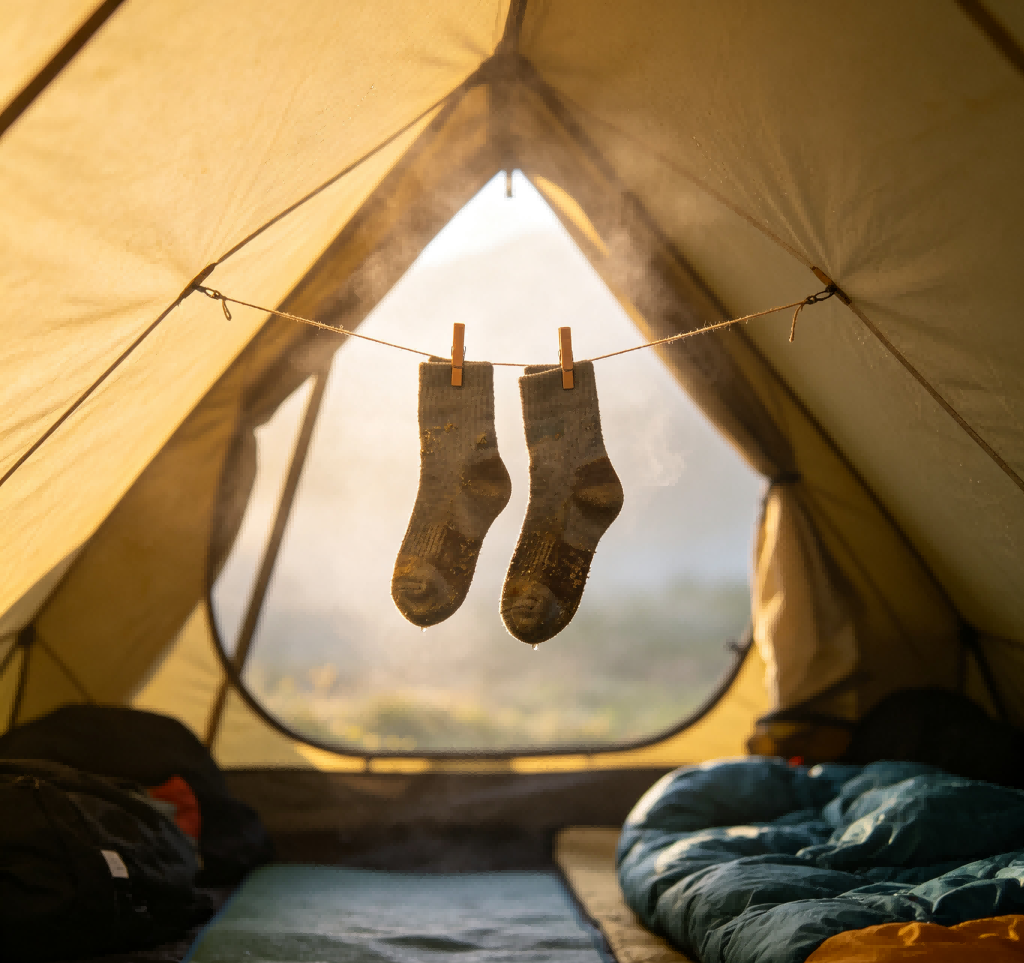
You should always make it a priority to change into a dedicated set of completely dry socks and dry base layers specifically reserved for sleeping.
Additionally, a hot water bottle that you’ve filled with freshly boiled water and tucked securely into your sleeping bag provides pure luxury and welcome warmth during cold nights.
Pro Tips:
Vent Your Shelter: While it seems counter-intuitive and goes against your instincts, you absolutely must vent your tent or shelter slightly to allow some airflow.
Every breath you exhale contains a significant amount of moisture vapor, and that moisture will inevitably condense on the cold inner walls and ceiling of your tent, then eventually rain back down on you or thoroughly soak all of your gear.
15. Improvised Tools & Repairs: Because Your Gear is Going to Betray You
Your gear will fail you. That knife will disappear when you need it. That pack will tear on a branch.
Survival isn’t about having the best gear; it’s about improvising solutions when your equipment fails.
A. Resource Scavenging
The landscape is a free hardware store. Use everything.
The Almighty Can: A metal can boils water, digs trenches, and polished, becomes a signaling device flashing sunlight for miles. Punch a hole, add cordage, and make a hobo stove that burns twigs efficiently.
Sticks, Bones, and Stone Edges: Lost your knife? A sharp stone (flint, chert, broken bottle) cuts game or wood. A pointed stick digs, spears fish, or roasts food. Fractured animal bones create razor-sharp edges.
Plastic Bottles: Indestructible and everywhere. Cut the top for a funnel. Lash two together for flotation. Store tinder or fishing gear. The practical workhorse of improvisation.
B. Bushcraft Repairs
When modern gear breaks, go medieval.
Pine Resin Glue (Nature’s Epoxy): Scrape golden sap from a wounded pine. Heat gently until liquid. Mix in crushed charcoal or powdered dung. This natural epoxy can:
◦ Haft stone to handle for an axe.
◦ Seal canteen cracks.
◦ Attach feathers to arrows.
◦ Fix boot soles.
Not Gorilla Glue, but close, and smells like Christmas.
Ingenuity Beats Gear:
Your best tool is your brain. A calm, creative mind outlasts expensive kits when GPS dies.
Seeing solutions in junk is the ultimate survival skill. Your ancestors had no Amazon Prime—just brains and stubborn refusal to die. Channel that.
Now fix something with a stick and tree snot.
Conclusion
Look, we’ve covered a lot. But this isn’t just a list to read and forget. These are perishable skills.
The goal isn’t to become a paranoid doomsday prepper. It’s to become a competent, confident human being.
It’s to reconnect with the fundamental skills that kept our ancestors alive—the same ancestors who would probably laugh at our automatic soap dispensers but would nod in respect at a well-built shelter and a strong fire.
Now get off your phone and go build a blanket fort. Your inner ancestor is waiting.